Four point eight percent.
That’s the conversion rate a founder read off his Shopify dashboard on a call last week. It wasn’t one lucky day, either. I’d pushed him to pull at least 30 days, and he gave me the whole quarter to date.
It stopped me cold. Most Shopify stores I audit convert somewhere between 1% and 2%. Getting near 4% happens, usually for brands that are seriously dialed in. Clearing it is rare. Clearing it by that much on a $150 to $200 considered purchase, in a market that’s real but nowhere near massive, borders on absurd.
So I said what I was thinking, which is that his prices were probably too low. (Not my smoothest consulting moment, but I stand by the logic.) If almost nobody hesitates at checkout, the price isn’t creating any friction, and no friction usually means money left on the table.
He had a better explanation.
When warm traffic inflates your ROAS
A meaningful slice of his site traffic comes from a partner. Customers of a much bigger brand get a notification pointing them to his store, with that brand’s stamp of approval attached. Those people show up ready to buy. Some of them were going to buy no matter what ad they saw.
That’s great for revenue and rough on your ad reporting. A referral visitor lands on the site, gets retargeted on Instagram, buys, and Meta counts the sale. Google counts it too, if they searched the brand name on the way back. Everyone’s dashboard looks fantastic.
When I raised it, his answer was blunt: everybody can take credit four times over, as long as profit goes up month over month.

I don’t hate that, honestly. What’s left in the bank after ad spend and costs is the one scoreboard nobody can game at the end of the month. Plenty of brands would be better off running on that blended view than on whatever Ads Manager says this morning.
The problem shows up when you try to scale. Warm referral buyers are a fixed pool. Double the spend, and the new money goes after cold people who’ve never heard of you. If your blended ROAS was propped up by customers you didn’t really have to acquire, the jump in CAC will hit harder than the dashboard suggests. You think you’re hitting your target. On truly cold traffic, you might not be close.
I saw a smaller version of this on Monday. One of my clients had an email blast go out the same morning we launched holiday promos, and ROAS in Meta looked unbelievable. I took that day’s numbers with a big grain of salt. I wrote last month about what happens when you misread your own account data, and this is the friendlier version of the same trap. The best-looking numbers usually deserve the most suspicion.
First-order profitability vs. lifetime value
He runs paid social with a simple rule: every first order has to be profitable. His target is a 2.5x to 3x ROAS on the first purchase, with no betting on repeat business to bail him out. He told me flat out he doesn’t want to play the “they’ll come back and buy an accessory” game.
He also prices his own site below what he charges on Amazon. On purpose. His margin is better selling direct, and more importantly, a customer who buys from his site lands in his CRM. From there they get marketed accessories, extended warranties, and eventually another purchase when they upgrade. That’s a lifetime value strategy, and a smart one.
So I pointed out that he’d just told me he didn’t care about lifetime value. He said he cares a lot about lifetime value. The first transaction just has to be profitable.
This founder is sharp. He’s built a real business. He didn’t see the conflict, though, and I’d bet a lot of operators miss it too.
Run the math with round numbers. Say a product sells for $200 and costs $120 to make and ship. That leaves $80 of gross profit, so break-even ROAS on the first order is 2.5x. Spend $80 to sell $200 and you’re even.
That’s the whole formula. Break-even ROAS equals your order value divided by the gross profit on that order. Fall below it, and every first order loses money.
Now cut the price by $20 to beat Amazon. The order is $180 and the gross profit is $60. Break-even ROAS jumps to 3x.

Every dollar you knock off the price to win the relationship raises the ROAS your ads need to clear on day one. You’ve made the customer more valuable over time and harder to justify today. And then the scorecard gives zero credit for the repeat purchases that were the whole reason you cut the price.
What you end up with is a brand that prices like an LTV business and bids like a first-order business. That caps how hard you can push spend, because a strict first-order hurdle puts a ceiling on what you’ll pay for any customer, no matter what they’re worth in year two.
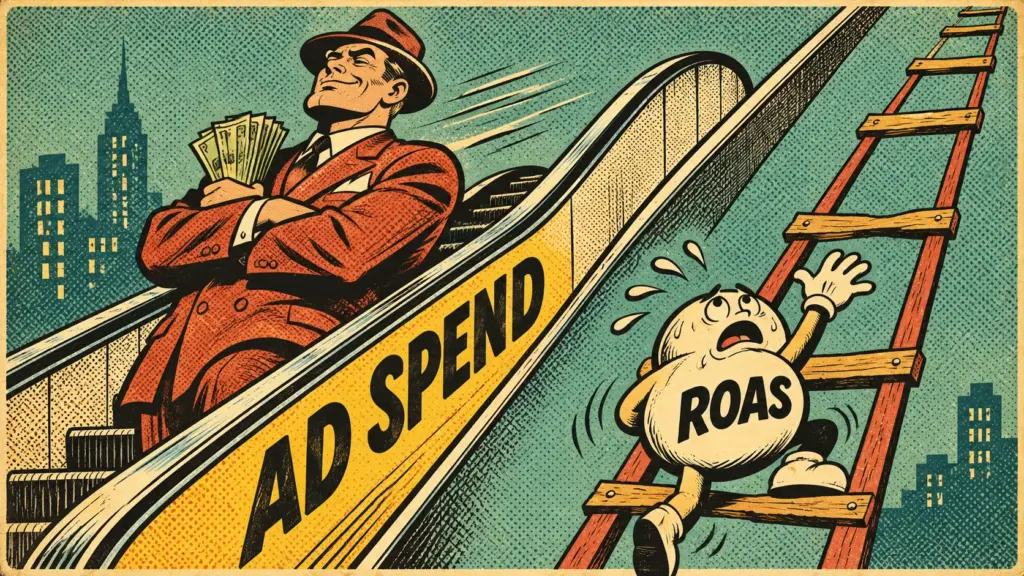
Why ROAS drops when you scale
He’s far from the only one holding out for 2.5x to 3x on every first order. I talk to brands every week that want 4x. Some of them even got it for a while, back when most of their spend reached warm audiences and their best-fit customers. Then they assume that number is permanent, and that if ROAS slips, scaling is off the table.
That gets it backwards. A hard ROAS line is one of the fastest ways to stop your own growth, and the reason comes down to how the auction works.
Every time Meta serves your ad, it’s placing a bet on who’s likely to buy, and it starts with the surest bets. On a modest budget, nearly all your money goes to people Meta already knows are in market: recent site visitors, people who look a lot like your existing buyers, people who’ve been clicking on products like yours all week. That’s the low-hanging fruit, and it’s where those early 4x numbers come from.
Then you raise the budget. There are only so many sure bets, so the new money has to reach further out. Meta has to show your ad to people it’s less certain about and learn who bites. Plenty of those impressions land on people who were never going to buy, and you pay for every one of them while the algorithm figures it out. The return on each new dollar drifts down as spend goes up. Nothing is broken. That’s what reaching new people costs.

How fast it drifts depends on how many people could plausibly want what you sell. A big addressable audience gives Meta lots of room to find the next buyer, so ROAS holds up longer as you scale. A narrower one runs out of easy buyers sooner, and the drop comes faster. The founder’s market is real but nowhere near massive, so he’ll hit that curve earlier than a brand selling something everyone needs. Two brands can chase the same target at the same spend and get very different results.
Scaling means buying volume. At some point that means less profit on each order, and you make it back on the number of orders and on what those customers buy later. More orders also means more people in your CRM, which is where the repeat purchases come from in the first place.
Volume helps on the cost side too. In most businesses, bigger production runs should bring the cost per unit down, and higher order counts give you more leverage with shipping and fulfillment partners. Some of the margin you give up in the ad account, you can win back in the supply chain.
How to lower your break-even ROAS
This is the part I’d underline. You have almost no control over the ad platform. CPMs have climbed for years, and I expect them to keep climbing. Feeds now run mostly on what Meta thinks you’ll like rather than who you follow, a model TikTok made standard, so your ad is up against the most engaging content on the platform for every scroll.
You can make better creative and run a tighter account, but you can’t make Meta’s auction cheaper.
What you can control is what it costs to make your product and get it to a customer’s door. Production, packaging, shipping rates, your 3PL contract, returns. Be ruthless about all of it.
Every dollar you take out of the cost of an order is a dollar you can spend acquiring the next customer. Go back to the math above and run it in the other direction: drop the cost of that $200 order from $120 to $100, and break-even ROAS falls from 2.5x to 2x. You didn’t touch the ads, and your ads just got a lot more room to scale.
First-order ROAS or LTV payback: pick one
Both models work. They just need different rules.
If first-order profit is the law, price for margin and accept that some bargain hunters will buy on Amazon instead. Let them.
If lifetime value is the strategy, then actually use it. He already has the CRM. Pull the real repeat rate and the 90-day gross profit per customer, and set a payback window that gives paid media credit for what it brings in.
Put some hypothetical numbers on it. Same $200 product with $80 of gross profit. Holding a 3x first-order target, say the account tops out around $20,000 a month before ROAS slips below the line. Loosen the target to 2x and it can spend $60,000. Assume the average customer adds $60 of gross profit within 90 days through add-ons, warranties and upgrades.
| Metric | 3x first-order target | 2x with a 90-day payback |
|---|---|---|
| Monthly ad spend | $20,000 | $60,000 |
| New customers | 300 | 600 |
| First-order profit | $4,000 | −$12,000 |
| 90-day repeat profit | $18,000 | $36,000 |
| Profit by day 90 | $22,000 | $24,000 |
The 2x account loses money on every first order. A strict first-order rule would have shut it off in week one. By day 90 it’s ahead, and it heads into next year with twice as many customers in the CRM, which is where the gap keeps growing. That’s what a payback window buys you.
Either way, split the warm partner traffic out of the paid reporting. Tag every partner link with UTMs so that channel reports on its own, and keep those buyers out of your prospecting numbers. What’s left is your real cold-traffic CAC, and that’s the number that decides how far you can scale.
He told me he hasn’t come close to exhausting what Meta can do for his brand. I believe him. He’s going to find out where the ceiling is. I’d rather he find it on purpose.
If you’re spending real money on Meta and can’t tell whether your ROAS target is protecting you or capping you, book a call and we’ll run the numbers on your account.