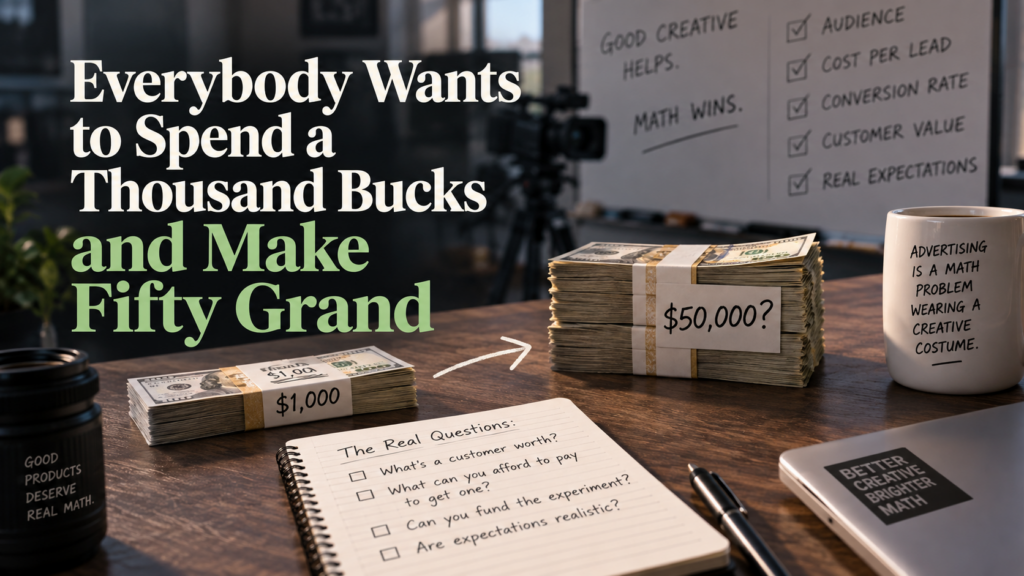
A founder told me last week that his ad budget was tight. Then he told me what he wanted out of it.
Fifty thousand a month in new business. Ramp up from there.
He was honest about it, which I appreciated. He even hedged before I could say anything: “You might tell me it doesn’t work like that.” He was right. It doesn’t. But he is not the only person who has said a version of that sentence to me this year, and the people saying it are not dumb. They run real companies with real products. Nobody has ever walked them through the arithmetic, and the arithmetic is the entire game.
The setup, with the details changed enough that nobody is identifiable. Service business. Custom work. Five thousand dollars on the low end, fifteen to twenty-five for a typical engagement, more when the client is a real corporation with a procurement department. Good product, good reputation, growth to date coming from word of mouth and a cold email tool that worked for a while until the inbox providers caught up to it.
So they want to run ads. Fine. Ads can work for that business.
Then we get to budget and the whole thing falls apart in about ninety seconds.
When you sell a five-thousand-dollar minimum engagement to a narrow slice of the market, you are not buying twenty-dollar leads. Your addressable audience might be a million or two million people in a country of three hundred and thirty million. That concentration costs money. Your CPMs climb because you are bidding against everybody else who wants that same small pool. The leads that come through are expensive, plenty of them still won’t be qualified, and some of the qualified ones will book a call and never show up.
Say a lead costs you $150. Say one in ten booked calls turns into a signed contract. You can do the rest of that math yourself, and if you can’t, you have a bigger problem than your ad budget.
None of this means don’t advertise. It means you should be prepared to spend the value of one or two jobs to find out whether the machine works at all. If a job is worth five grand, be ready to push five or ten thousand through the account before you draw any conclusions. Not because that is what I would like you to spend. Because that is the sample size required to learn anything.
A thousand dollars a month in a category like that buys you a rounding error. You get a handful of clicks, maybe two leads, one of whom wanted a favor and the other of whom filled out the form by accident. Then you decide Facebook ads don’t work, and you tell people that at parties for the next three years.
If a couple hundred bucks in ad spend reliably produced five-thousand-dollar customers, every one of us would have quit our jobs already. We would all be on a beach somewhere refreshing Ads Manager. The fact that we are not should tell you something. Anybody promising you leads at that price is trying to close you, not help you.
Here is the part of that call that stuck with me, though.
This company is a content production studio. They make video for a living. Their ad creative was already shot, already good, already sitting on a hard drive waiting to be trafficked. That is the piece almost every advertiser gets wrong. Most brands have a decent product and forgettable creative, and they spend a year and six figures learning that their ads are boring. This guy had the hardest input solved on day one.
And the math still didn’t work at a thousand a month.
Great creative lowers what it costs you to acquire a customer. It does not repeal the relationship between what you spend and what you are able to learn. The platform still needs enough volume to find your buyers, and you still need enough conversions to know whether the buyers it found were worth anything.
Advertising is a math problem wearing a creative costume.
Figure out what a customer is worth to you. Figure out what you can afford to pay to get one. Then decide whether you can fund the experiment that tells you if that second number is achievable. If you can’t fund it yet, that is a real answer, and it is a much cheaper answer than the one you get in March after six months of burning money and patience.
To his credit, he took it well. He said he would go back to his partners and reset expectations before anybody launched anything. That was the cheapest thing he did all week.