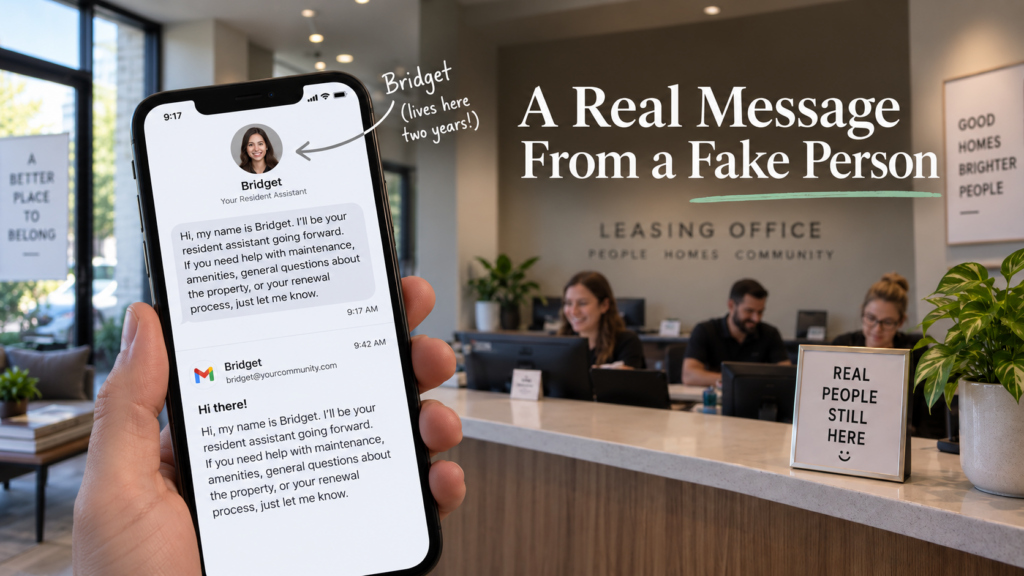
Bridget texted me this morning.
“Hi, my name is Bridget. I’ll be your resident assistant going forward. If you need help with maintenance, amenities, general questions about the property, or your renewal process, just let me know.”
A little while later, an email showed up. Same Bridget. Same line about maintenance and amenities and the renewal process, word for word, with a little warmth bolted onto the front. She’s lived here two years herself. She works with the team. She wanted to introduce herself.
Two years. Nice touch.
I walked down to the leasing office and played dumb. Asked if I needed to talk to somebody about my lease, said I got some text message. I already knew the answer, but I wanted to hear how they’d say it. The woman behind the desk was cheerful about it: oh yeah, that’s real, that’s your AI assistant.
So it’s a real message from a fake person. Good to know.
There were three people sitting in that office. Nobody was on the phone. Nobody was with a resident. I was the only person who had walked through the door, and I only walked through it because a robot pretending to be a two-year tenant had texted and emailed me inside the same hour. Whatever efficiency they think they bought, I spent it walking downstairs.
I want to be clear about something before this turns into an anti-AI post, because it isn’t one. I use this stuff every single day. It writes code with me, it audits ad accounts with me, it drafts the first pass of things I’d otherwise put off until Thursday. I’m not the guy who thinks the machines are coming for the leasing office. I’m the guy who wishes the leasing office had used them better.
Here’s what went wrong, and it has nothing to do with the technology.
Nobody in that office sat down and decided to deceive me. They bought a piece of software, and the software came with a name and a personality and a backstory about living onsite for two years. Some vendor’s product team decided that residents respond better to a person than to a system, ran a test that probably showed a 4% lift in response rate, and shipped it. The complex signed the contract. Bridget was born.
The problem is that the disguise only works on people who don’t notice, and by now, almost everybody notices. Two identical messages across two channels within an hour. Corporate-brochure phrasing. The unprompted detail about how long she’s lived here, which is exactly the kind of thing a real neighbor would never lead with. My mother would catch this. The trust doesn’t erode gradually when you spot it. It just falls over.
And what it cost them is bigger than the text. Every future message from that number is suspect now. Every email from that address gets a half-second of “is this a person?” before I read it. If they send me a legitimate renewal offer in January, I’m going to read it like a phishing attempt. They spent the trust they hadn’t even built yet.
Now run the same play the honest way.
“Hi, this is the automated assistant for the leasing office. I can open maintenance tickets, answer questions about amenities and your lease, and connect you with the team during business hours. Text me anytime.”
I’d have used that. Happily. It’s 11pm and the garbage disposal is making a noise, and I would much rather tell a bot about it than leave a voicemail that gets picked up Monday. The bot is genuinely better at that job than the three people in the office, because the bot is awake. Say what it is and I’ll use it for what it’s good at. Dress it up as Bridget and I block the number, which is what I did.
The lesson for anybody deploying this stuff in front of customers: the disclosure is free and the pretense is expensive. You are not fooling people into liking your AI. You’re only teaching them to distrust everything else you send.
Anyway, I got my lease questions answered by an actual human who was sitting there with nothing to do.
Bridget’s been here two years. She’ll be fine.