About halfway through an audit call last week, after we’d covered the broken pixel, the campaign structure, and the 65-year-olds quietly eating the ad budget, I asked the question I now ask on almost every call.
“Are those reviews on your site real?”
Pause. Then one of the founders said, “No, not all of them are.”
I already knew. I’d known since I scrolled the product page before the call started. And it wasn’t the first time. Over the last few months I’ve seen some version of this on audit after audit, almost always on startup DTC brands running on Shopify. Sometimes it’s a few made-up reviews padding out a thin section. Sometimes the whole section is invented. Either way, it’s painfully obvious.
This particular brand was an international pet supplement company, run by sharp founders spread across three countries, selling into the U.S. Nothing about them was shady, which is the part that keeps surprising me. Fake reviews used to be the dropshipper’s move. These days I find them on stores run by perfectly reasonable people who assumed everyone else was doing it.
And once you’ve seen enough of them, they stick out the same way AI-written LinkedIn comments do. You know the comment I mean. “Great insights! This really resonates with me.” You’ve clocked it before you finish the first line. Fake reviews give off the same smell. The tells are just different.
How I spot them (and how your customers do too)
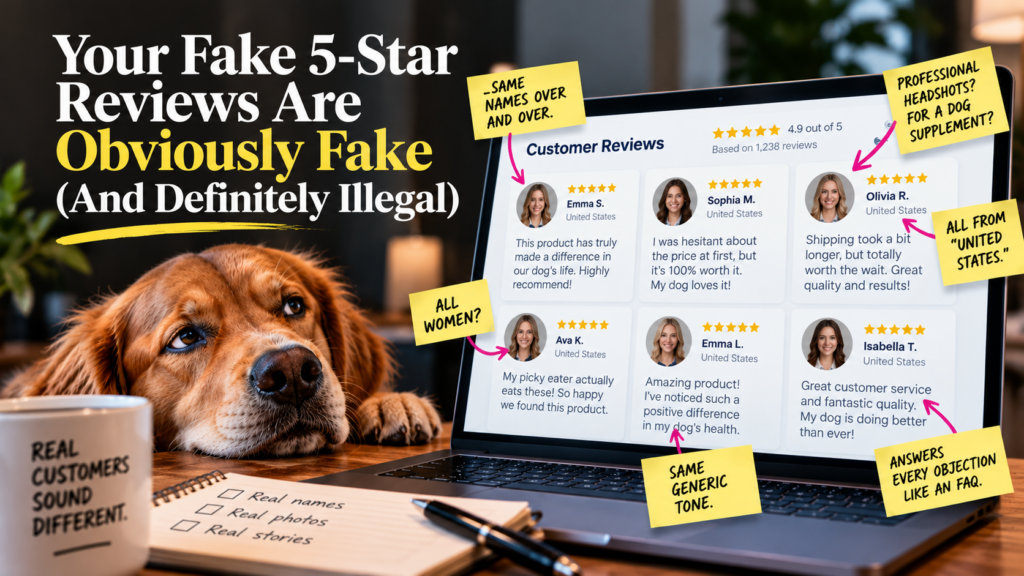
The baby name book. Emma. Sophia. Olivia. Ava. Then Emma again. Real customers are named Deb, or “Mike T.,” or a Gmail username with four numbers on the end. When every reviewer sounds like she was named off the same list of popular baby names, somebody made them up.
Every single reviewer is a woman. On this site, all of them. Plenty of women buy dog supplements. Plenty of dog dads do too. A 100% female review section doesn’t look like a customer base. It looks like a person picking names.
The headshots. Professional, well-lit, LinkedIn-ready headshots next to a review for a dog chew. Nobody uploads their corporate headshot to review a supplement. Real people post a blurry photo of their dog on the kitchen floor, or no photo at all.
Location: “United States.” That’s it. Not a city, not a state. Real review apps pull whatever the customer entered, which is usually something specific, or nothing.
The tone. “This product has truly made a difference in our dog’s life.” Whose dog? What breed? How long did it take? Did she actually eat the thing? Real reviews are full of oddly specific details because real people are describing a real Tuesday. Fake ones float at 30,000 feet because whoever wrote them never opened the box.
The reviews that answer your objections. This is the one that gave this site away. Review after review spoke directly to the exact reasons someone wouldn’t buy. Something like “I was hesitant about the price at first, but…” or “I worried my picky eater wouldn’t touch these, but…” or “Shipping took a bit longer since it comes from overseas, but totally worth it.” (I’m paraphrasing the pattern here, not quoting their site.)
They read like an FAQ page with first names stapled to it. Real customers don’t write rebuttals to your sales objections. They complain about the lid. My guess is someone listed every objection they’d heard and asked an AI to answer each one in the voice of a happy customer. Which is exactly how it reads.
The harmless one-star reviews. This one is sneakier, because somebody clearly knew a wall of five-stars looks fake. So they sprinkled in a few one- and two-star reviews for variance. The giveaway is what those reviews say, which is basically nothing. Something like “Didn’t really work for our dog.” That’s the whole review. A real one-star review comes from someone who would have given you zero if the form allowed it. It’s angry, and it’s specific: the bag arrived torn, or customer service ghosted them for two weeks. Same goes for the twos and threes. A low rating with no reason attached reads like someone filling a quota.
The founders told me not all of their reviews were real. After reading the low-star ones, I’d bet all my Schrute Bucks that none of them were.
Why an ads guy cares about your reviews
Here’s the part that matters to me. You’re paying Meta to send cold traffic to a page. That person has never heard of you, and the review section is one of the first places they go looking for permission to buy. If the reviews smell fake, they don’t just discount the reviews. They discount everything else on the page too: the ingredient claims, the guarantee, the founder story.
That store was converting at under 1%. There were other problems, sure. The tracking was a mess and a lot of the traffic wasn’t real buyers. But I’d bet the reviews were a big piece of it. People see them and the reaction is immediate: this feels like a scam. Once a visitor thinks that, nothing else on the page matters. The founders thought the reviews were helping. In most cases like this, I think they’re doing more harm than good.
There’s also the small matter of it being illegal. In August 2024 the FTC finalized a rule banning fake consumer reviews and testimonials, and it specifically covers reviews written for people who don’t exist, including AI-generated ones. It also applies when a business “knew or should have known” the reviews were fake, and the maximum civil penalty was set at $51,744 per violation. If you sell into the UK, the Digital Markets, Competition and Consumers Act banned fake reviews as of April 2025, and the CMA can now fine companies up to 10% of global turnover. (I’m not a lawyer. Ask yours. But you don’t need one to know which side of this you want to be on.)
What to do instead
If your reviews are fake, my honest advice is to turn the review section off. Today. Leave it dark until you have enough legitimate reviews to fill it. A product page with no reviews reads as new. A product page with fake reviews reads as a scam, and new is a lot easier to recover from.
You don’t need 200 reviews. You need enough real ones that a skeptical stranger believes you.
Get product into real hands early, and if you send it free in exchange for an honest review, say so on the review. That’s allowed. Hiding it isn’t.
Time your review request for when the customer actually has something to say. For a supplement, that’s a few weeks in, after the dog’s had time to show a difference, not two days after the box lands.
Use a review app that marks verified buyers and shows dates, and leave the dates showing.
Keep the four-star reviews, including the one that grumbles about shipping. A wall of perfect five-stars is its own tell. One honest complaint makes every positive review around it more believable.
And ask for photos. A real dog on a real floor beats any headshot you could buy.
Real customers write like real people. They’re specific, a little sloppy, and occasionally annoyed. If every review on your site sounds like it went through a marketing department, your customers will assume it did.
